
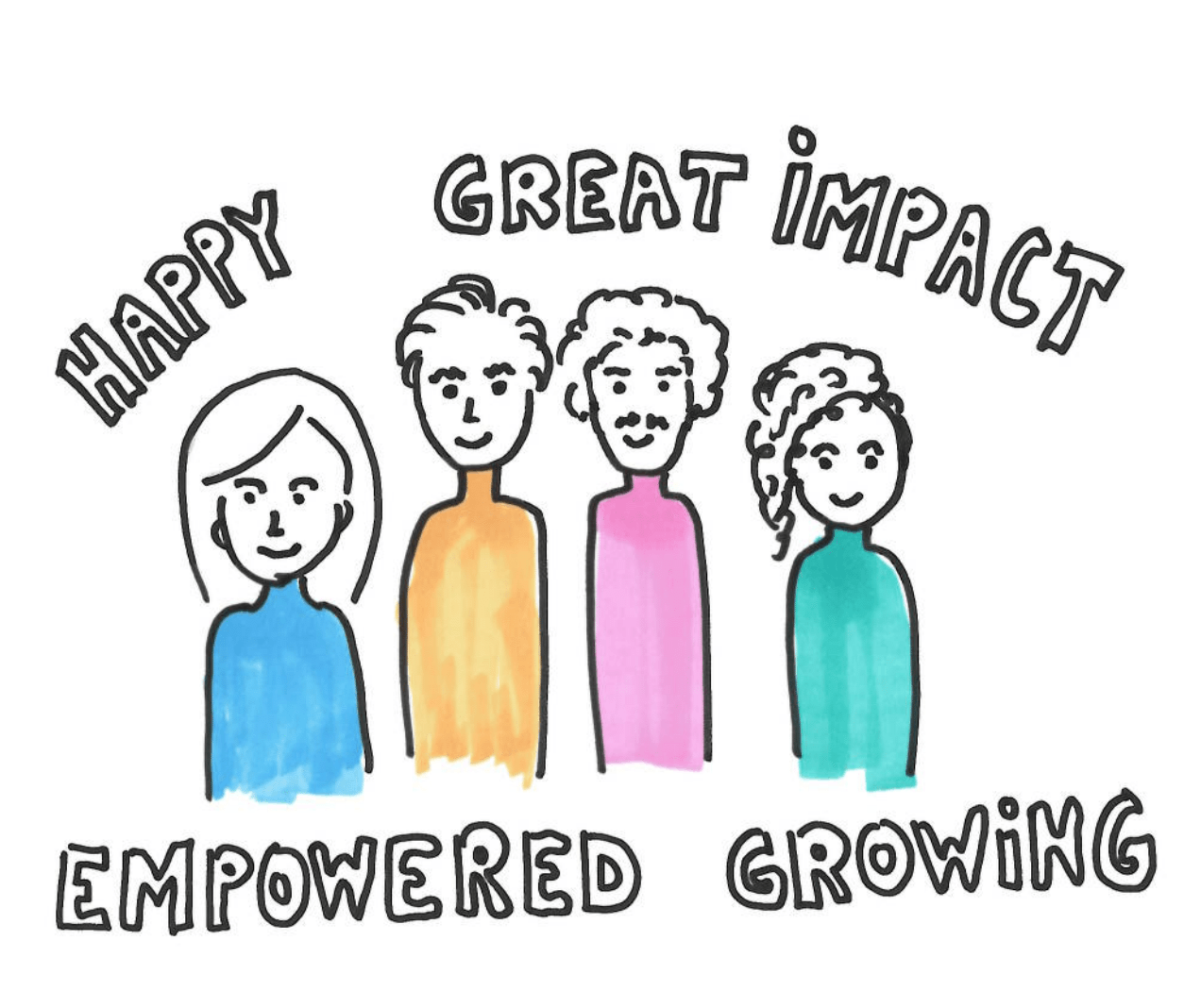
The people in our organization are key for our success as a company. As leaders we want to support the people and teams to have impact. We want to make sure they have what they need to deliver great and we want to make sure they are growing their skills and behaviors. In this post I have summarized some of the things we do as leaders to support the people and teams we work with.
Posts related to supporting people and teams can be found under the Supporting People and Teams category.
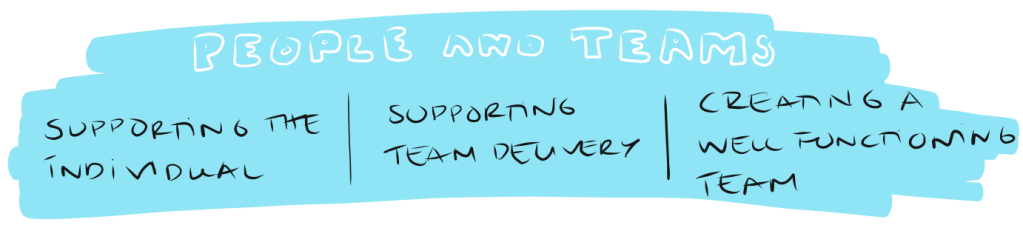
Supporting the individual
Presence in the day to day work is something that is really helpful in your support since you will be able to learn a lot about the person by collaborating or observing them in their day to day context. Having more context around the things the individuals are working on will also help. Another benefit is that you will have a better chance of giving relevant feedback just-in-time and you will also be easier to approach for the individuals.
1:1s. Important tool for the individual support. In 1:1s you get the chance to get really close to an individual and build a strong relationship with a high level of trust. Trust is super important for everything else that you will do to support the individual. Read more in this post .
Coaching. As a servant leader you always want to support the individual to take their own decisions why coaching is a super valuable tool. As the manager it is important to balance coaching and mentoring depending on situation and the seniority of the person you are supporting. I plan to write more about how I do coaching in my manager work.
Feedback. This is an amazing tool for growth and improvement. It has taken me some time to comfortably give people constructive feedback but wow how powerful it is when you can do that in an open way with people that you work with. The level of growth and insights you can get when it is easy to be totally honest with someone is amazing. In this context I can not stress enough how important it is to build a relationship with lots of trust and to deliver you feedback in a way that it is easy for the person to receive (and I don’t mean sugar coating, I mean that you should spend time formulating your message in a way that the person understands and can take to heart). I have written another post about my learnings from the feedback space.
Motivation sessions. Sometimes you need to help an individual understanding frustrations, lack of motivation or help them getting ideas of where they might want to take their careers or growth and then it could be good to do a session to get a deeper understanding of the motivational drivers for this individual. Examples of sessions that I have been using can be found in this post.
Finding answers to questions. As a servant leader you want to support your people so that they can do a great job. When I have the chance I try to help them with things that I can do. This is a way for me to off-load them and also to show them that I want to help and that I am not afraid of rolling up my sleeves and do the work when that is needed. I will balance these helping out activities with allowing people to drive things themselves to make sure that I am not removing any growth opportunities by helping out.
Drive change when needed. When things are not working properly we might need to help individuals through driving change initiatives that will improve the situation. The changes needed could be anything and depending on the organization and your sphere of influence the actions you take will wary. Read more about driving technical change in this post, it might be helpful even if you are not about to drive a technical change.
Communicate when needed. When people have a clear picture of what is going on and why they will be able to take better decisions and feel more in control of things. As a manager you have a great opportunity to create an environment where it is clear to people where we are right now, where we are going, what they can expect from us in management and what it expected from them. I find it valuable to spend time to create a clear communication around change processes we are in, high level strategies, clarification of the compensation review process and similar.
null
Supporting Team Delivery
Planning. A big topic for any team. You always need a plan but you don’t want to spend too much time on creating that plan since you want to spend most of your time on doing work – not talking about work. That said it is super important that we do spend our time on the right things why planning is crucial. Another thing that is true about plans is that they will always change since the world is changing around us. I think it is totally fine to change your plan but it is always better to have one to change so we should never use uncertainty as a reason for not creating a plan. There are lots of methods for planning and running agile delivery and as a manager you need to be able to support the team regardless of the method they are using. You need to identify when planning is not as efficient as it should, when we fail to plan enough and when we spend too much time on planning.
Estimation or forecasting. You also need to be able to help the team understanding their capacity and the complexity of the work they are taking on since it is important that they are taking on the right amount of work to succeed (not too little nor too much). I am fond of low effort methods where we don’t spend a lot of time estimating but instead try to learn from our past experiences and use forecasting to increase our predictibility.
Creating a well functioning team
Retros. Continuous improvement is a wonderful thing! So powerful to take small improvement steps all the time instead of a few big leaps. With a proper continuous improvement mindset failing is not that dangerous which will encourage you to take bigger risks that can lead to innovation that you otherwise would miss out on. Efficient teams work with retrospectives on a regular basis. The retrospects can be open and work on identifying things that are working well or not so well but they can also be targeted towards a specific topics like feedback culture in the team or an increased amount of incident. Having retrospectives to identify improvement opportunities is powerful tool but only if we actually do something about the things we identify. As a leader you need to make sure that the team is following through on their actions and hold them accountable otherwise and look into the reasons for not following through. Maybe too many actions are agreed upon with the result that none of them are happening.
Team Health. Teams need to work well together to deliver great impact. Everyone needs to feel at home in the team and have what they need to successfully deliver great value in the team together. The team needs to communicate with each other in a good way, work in a sustainable pace and be proud about their accomplishment. They need to feel like they are learning and improving and have fun while working together. As an engineering team it is also important that people feel proud about the code that is produced and the quality of their services. As a manager you need to monitor how the team is doing to identify when you need to take actions. One way to monitor this is to talk to people in the team about how things are going but it is also good to take a more structured holistic approach to measure the team health. This could for instance be done with a team health survey that you do a few times a year or so.
Team dynamics. There are lots of research around team dynamics and what kind of support a team needs in different situations. One thing that is clear is that a well functioning team is not a constant thing, any change in that team will have impact on the team and could have impact on the team productivity. A team goes through different phases and will need different kind of support during these phases.
- A newly formed team will need help getting to know each other and find their ways of working. In this phase people generally are very friendly and flexible with a clear focus on wanting to make things work.
- As the people in the team gets more comfortable with each other they will become more comfortable raising their opinions even when they disagree and it is not uncommon that conflicts arise in this phase. As a leader in that team you will need to support potential conflicts and help creating an atmosphere where people are honest in a constructive and respectful way.
- When people have established themselves in the team and know more about each other the team is becoming productive. They will stumble into situations where disagreement or misalignment appears but have an open climate where they can handle these kind of issues and will be needing less support to move forward from such a situation.
- The final phase is the truly productive team where things just work. People collaborate without thinking of it and experience themselves as a well oiled machine that can take on any challenge that comes a long since they are so strong together. This kind of well functioning teams are in my experience very rare which is not that surprising since few teams stay stable for a long enough time without any change coming their way.
Techniques that can help
Facilitation. Supporting a teams impact is a lot about supporting a team in their collaboration. Lots of activities the team does together are in some sort of meeting form why great facilitation skills are a big asset. Several things are important to make a meeting successful and you need to master them all:
- Setting the right goal for the meeting to get the outcome needed. giving the context needed about background and purpose to get people on the same base.
- Providing a structure that will get you the outcome needed and enable people to contribute efficiently and inclusively.
- Driving the meeting. Making sure we are following the plan, keeping track of time and adjusting the agenda when needed.
- Facilitate the conversation in the meeting. Summarize what is being said and clarify the decisions that are being made
- Ending the meeting. Summarizing the outcome and make sure we have defined next steps when needed.
- Making sure documentation from the meeting are taken and that the results are communicated to the right people.
In the meeting you need to make sure that all perspectives come into play, that all participants feel included and gets heard and that the conversations are moving in the right direction to reach the output you are after. This require active leadership from you in the session and you often need to think quickly and adjust the agenda/discussions along the way, If you as a person are more comfortable with structured discussions than more fluid discussions where the next steps are defined by the outcome of the discussion you should probably choose a structure for the meeting that enable you to facilitate the session in a good way. If the meeting is going in the wrong direction or the discussion is not productive a good thing is to end the discussion and in some cases end the whole meeting. I know from experience that it is easier said than done but I still encourage you to do it in such situations.
Getting people onboard with your ideas. As a leader in the team you might end up in a situation where you want to communicate something to the team that it is not given that the team will agree with. You want them to understand what you are saying and understand why you think this is a good thing. In these situations you need to think carefully about the message you are sending and in my experience the most important thing is that you send a message that you believe in. Even when you have to communicate something that you might not fully agree with, you need to find a way to reason about it that you buy in to yourself, otherwise people will see your doubts and challenge you on them. When you have formed a message with your own words you need to think about what people will hear when you tell them the message, what they will be concerned or worried about and why, which questions will they ask and which disagreements might come up. The more you know about the perspective of others the better you will be at phrasing the message in a way that people will understand and hopefully 🙂 agree with. Doing this exercise will also prepare you in the sense that you will improve your message and believe in it even more.
 Engineering Leadership in Practice by Åsa Ranneby