
As leaders in an organization we want to support great impact. We want the decisions taken to balance short term and long term success and that our strategies are good, clear and that we are aligned in our interpretation of them. In this post I have summarized some of the things we do as leaders to support the impact of our teams from both the business and the technology perspective. .
Posts related to supporting business and technology impact can be found in the Support Business & Tech category
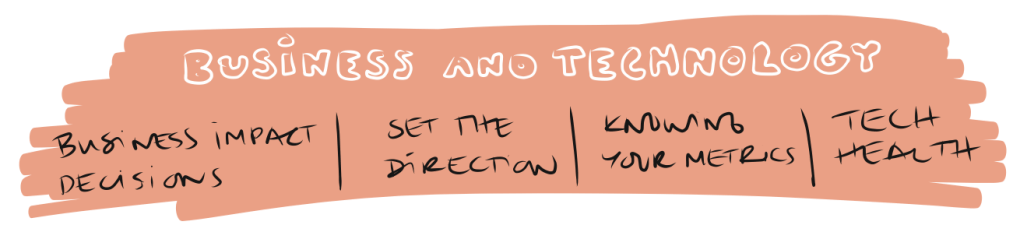
Business impact decisions
Priorities. In all organization we need to prioritize the work that we do. We need to decide what we are going to do and the things we are not going to do. There are lots of different models for doing prioritization that can help you do this. My opinion is that regardless of model you need to make sure to base your prioritization decisions on business impact and even when it is difficult to get good metrics in place for the impact you need to reason about the impact before taking decisions. Another thing that I believe strongly in is that you need a low effort tool to define the business impact since you don’t want to spend too much time estimating and planning work but instead spend as much time as possible doing work.
Knowing your Metrics. The team needs to be aware of how they are doing and one way of getting there is to be on top of your metrics. It can be the company metrics you try to move, the data coming back from an A/B test, the reliability and performance metrics or some metric the team can use to keep track of their own speed. Your job as a manager is to make sure the team is working actively on taking metric driven decisions and help them get there if they need support.
Set the direction
Clear vision, mission and strategy. In many organizations there is a product organization that is responsible for setting the vision and strategy. When that is the case one thing you as a manager might need to help with is communicate that strategy or support product in getting the vision into place. As a manager you will need to be able to create a strategy if that is needed, either by setting the direction yourself or by facilitating that process in collaboration with others. Setting a strategy in a way where people can take part on defining parts of the strategy is a very good way to create buy-in and make people engaged in applying the strategy.
Defining the tech strategy. If there is a lack of technical strategy that will help us take good decisions that position us well for the future you will need to support the creation of a tech strategy. Creating a great tech strategy might or might not be included in the responsibilities of you as the manager but regardless of that you will have to support the creation of the strategy if that is needed. Depending on your needs a tech strategy could for instance be about defining a target architecture, taking decisions on which technologies to use or defining what good looks like and creating guidelines for how we build our tech. The strategy that we define should help us take good and aligned decisions in our day to day work.
Learning and Innovation
Learning and innovation. When focusing on delivery you might not get into innovative mode or get enough space to develop your skills or share knowledge with others. For us to be long term successful we need to get into creative thinking and learn new things why we need to make sure we have enough of that in our day to day work. One way to achieve this could be to do “hacking events” or focused efforts to increase learning. As a manager you need to make sure that people in the organization is developing their skills and that we continuously improve our skillset as an organization. A low effort way to share knowledge (and practice people’s teaching/presentation skills is to organized lunch and learn sessions where someone holds a presentation about a topic, a system for a group of people. You could also watch a video together and discuss the contents together afterwards. Mob or pair programming is also a technique to increase learning in your team. Helping teams increase pair programming or close collaboration in the team and encourage them to try out mob programming is something you can do.
Tech Health
Tech Health. It is important that the teams are monitoring the quality and health of the systems they own. Quality in this aspect could be things like number of bugs, test coverage, performance, stability, recoverability, accessibility, security or tech debt as in unnecessary complexity or unused code. A team needs to be aware of their current state of things and make sure to improve things when needed. We need to continuously improve our tech to make sure that we don’t get slow in the future. Having a plan for improving tech that can be prioritized together with the business priorities is important and as a manager you need to support the team in putting this into place if needed. The same goes for making sure that the team is using good engineering best practices to ensure good tech solutions both short term and long term.
 Engineering Leadership in Practice by Åsa Ranneby