
As a manager your job is to support others to enable them to have great impact and at times it can be hard for you as a manager to measure your own success and feel accomplishment in the work that you do. Compared to engineering, where you get instant feedback from compilers and tests, the impact of the leadership work is indirect and the feedback loop much longer.
Even though I have seen that my manager work has impact on the people I work with, getting the full sense of accomplishment has from time to time been a struggle for me. One thing I have learned is that looking at my own performance in a structured way, helps me to look at things from a holistic picture.

Doing a self assessment
Self assessment by reflecting on the impact you have as a manager is a great way to get a picture of how things are on a holistic level. Doing this is also a great way to identify new improvement opportunities and goals you would like to achieve going forward.
When looking at the impact of my leadership work I start by looking at the overarching goals of my leadership work. I use the engineering leadership categories that I have defined and for each of them I look at the impact I have had from the dimensions value added, growth/improvements and happiness.
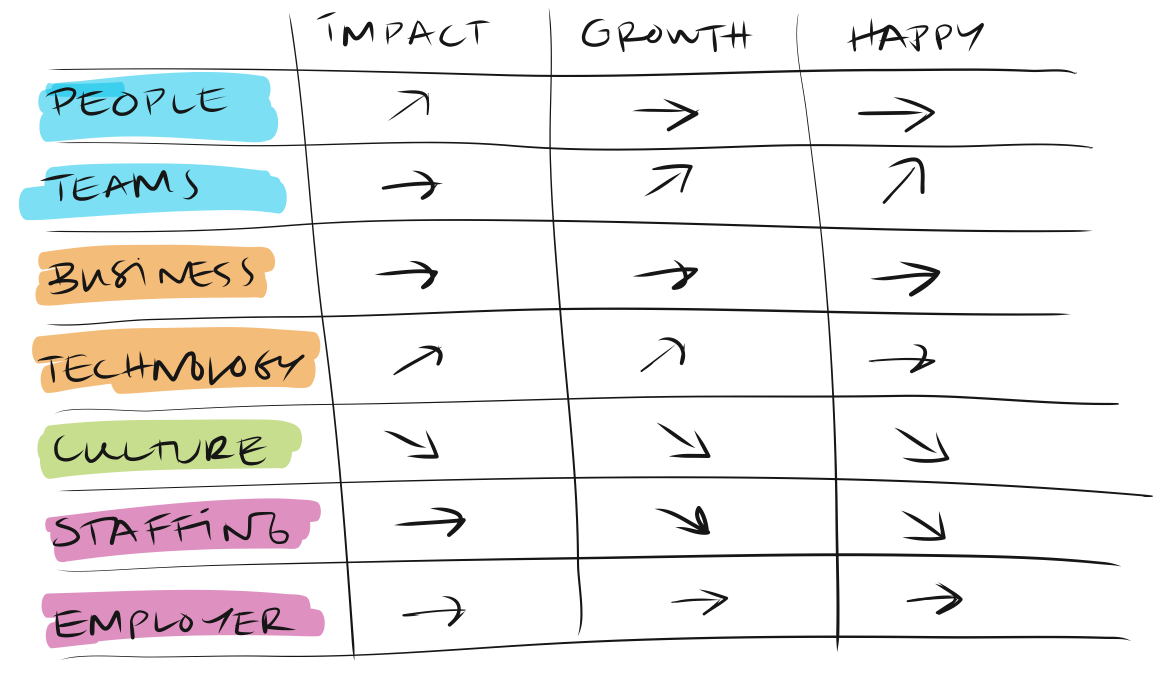
Value added (impact)
Are we having great impact in the organization? Which impact have my leadership actions led to in each of the categories? Which actions have I been taking in each of the categories and what value has come out of those actions?
- For people the goal is that people deliver great impact to the company, while they are continuously growing both skills and behaviors and enjoying their work. The impact I want to deliver as a leader is the support needed for people to do that.
- For teams the goal is to deliver great impact to the company, while continuously improving their collaboration, sharing knowledge and having fun together. The impact I want to deliver as a leader is the support needed for them to do that.
- For business the goal is to deliver the right impact based on the company strategies. As a leader I want to make sure that the teams see the bigger picture and knows where the company is going and why. I also want to make sure they have clear strategies and see a clear purpose of the work we are doing. Ensuring a focus on user impact and metrics is also important.
- For technology the goal is to build great technology using good engineering best practices and keeping the tech debt in shape by balancing the short term deliveries with long term speed. As a leader I want to deliver the support needed for them to do that.
- For culture it is about making sure that we build a great inclusive culture and provide leadership aligned with our company values. We want our culture to be an awesome place to work for everyone. As a leader I want to make sure that we are driving improvement initiatives and are in control of our current state.
- For staffing it is about ensuring that we are staffed appropriately and hiring in the right pace with high quality. As a leader I want to have a staffing strategy in place to ensure the right staffing. I always want to know the current state of hiring and make sure that we are doing the improvements needed to ensure a fast and high quality hiring process.
- For being a great employer it is about maintaining a good employer – employee relationship and always act when things are not working. We also want to make sure that career progression and compensation are good and fair. In short, the goal is to make us the best employer in the world. My goal as a leader is to do what I can to fulfill that goal.
Growth and Improvements
Is the organization growing? Which growth or improvements have my leadership actions led to in each category?
- For people this is about the development of the individuals. The goal is that they continuously grow both skills and behaviors. This is important when things are not working as they should but it is as important when things are working because we want people to stay challenged and learn to keep motivation on top.
- For teams this is about the improvements in collaboration and ways of working with the goal of becoming a truly high performing team.
- For business it is about improved capabilities to deliver impact with the goal of everyone knowing what to do to deliver as much value as possible in alignment with our company strategies
- For technology it is about improvements of our technology with the goal of always having a great balance between tech debt and innovation. We need to make sure that we are improving and moving towards our tech vision in a great way
- For culture it is about improvements in our culture with the goal of being an awesome place to work for everyone
- For staffing it is about improvements needed to ensure that we are staffed appropriately, hiring in the right pace with high quality
- For being a great employer it is about improvements with the goal of making us the best employer in the world.
In the points above I am not specifying knowledge sharing separately even though it is a critical aspect of becoming a successful organization. Since growth is important, sharing knowledge is an important aspect of all the categories since the better we are at sharing knowledge, the more growth will we see in the organization.
Happiness
Are we happy with the current state in the organization?
The intention with this dimension is to assess how happy I am with the current state of things in each of the categories. This information will be helpful to get an understanding of if I have been working with the right priorities or if I should change anything going forward.
- People. How happy are you with the current state of the people you are working with? How happy are they?
- Teams. How happy are you with the current state of the teams you are working with? How happy are they?
- Business. How happy are you with the current state of business for the people and teams you are working with? How happy are your customers and stakeholders?
- Technology. How happy are you with the current state of tech for the people and teams you are working with? How happy are the users of your systems or other teams depending on your technology?
- Culture. How happy are you with the current state of culture in the organization? How happy are people around the organization about working with your organization?
- Staffing. How happy are you with the current state of staffing in the organization? How happy are people around you that you are collaborating with in the hiring? How happy are the candidates?
- Being a great employer. How happy are you with the current state of the company as an employer? How happy are the employees? How happy are people outside of the company about you as an employer?
Asking others about your impact
Another thing I have tried to assess how I was doing as a manager was to ask the people that I was working with for their perception. This was a good way to get a broader perspective of the current state of things in the people category.
In general, asking for feedback about particular things is something I do regularly in 1:1s and such but in this example I took a more structured approach and sent out a questionnaire where I asked my direct reports about their current state in different dimensions.
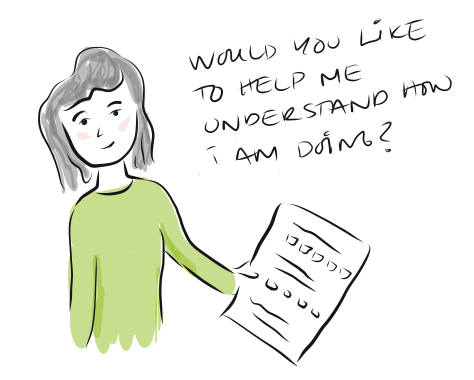
I sent out a questionnaire with a number of questions related to how things were for the individual. When they had entered in their answers we had a session where we looked at their answers together. That was a really good way for me to understand the current support they were experiencing and to identify the things that we could work on improving together.
Questions that I asked in the form (the questions had a scale from 1-5 combined with a text field for comments or explanations):
- How much fun is it at work?
- How happy am I with my current delivery of stuff?
- How challenged am I in the work I am doing?
- How happy am I with my current development?
- How empowered am I feeling in the workplace?
- How clear is my picture of where the company is going and why?
- How clear view do I have of what is expected from me at work?
- Have I received feedback from someone during the last month?
- How valuable was the feedback I received? Will it help me grow?
- What was the feedback?
- Have I been giving someone else feedback during the last month?
- What was the feedback I gave?
- When I go home at night, do I feel like I have the energy to keep on working in this pace the upcoming months?
Doing this a couple of times a year could be a relevant data point for tracking your impact as a manager. As always you have to be mindful about people’s time, if you are asking for input on similar topics in other contexts (great place to work surveys, team health surveys, …) it might not be a good idea to do this on top of all that.
How do the expectations change as you become a more senior manager?
The more experience you get, the bigger challenges you can take on. But regardless of seniority, all managers need to fulfill the same goals, we all need to do whatever it takes to support the people in our organization. An unexperienced manager needs to do the full job but might need more support along the way. A more senior manager will be able to do it with more ease, managing to fit in more work on the side.
In my work I have been asked how the expectations change when becoming a senior manager and other managers have asked me to help them assess how far along they are on their own manager journey. I don’t think there is one right answer to the question of manager seniority, it depends a lot on the context you are in, the career frameworks you have available and the roles you have in your company but I will share some thoughts on the topic based on my experiences.
Generic traits of Senior Managers
Complexity in problem spaces. In general I think that more senior manager can take on bigger problems and define more complex strategies. They will be able to tackle more difficult dysfunctions and will be comfortable starting up new teams or drive organizational change. They will be able to drive change in a way where people wants to follow along.
Smoothness in execution. More senior managers will be able to proactively identify improvements or opportunities earlier, enabling them to take a more strategic approach to their work. When being earlier on the ball, it is easier to identify needs for communication and have enough time to plan. This will help making the execution phase smoother and the journey more comfortable for everyone involved. The smoothness also comes from excellent communication skills, high awareness of when we need to communicate, what we should say and how we should say it to reach our audience in a good way.
Driving improvements in the org. More senior managers will be doing more teaching and mentoring. They will do this to help others but also to improve the leadership we are providing in the org. They will be good at describing what is important in our leadership and how we should apply our values to be successful. They will also be good at identifying needs for improvements in the organization and able to build a culture where people thrive. They will be able to balance these improvements with delivering company value in a good way.
Leadership maturity. More senior managers will be self-aware about their own behaviors and how to apply them to influence others in a certain direction. They will be using self-reflection and feedback loops to continuously improve their own leadership skills. They have developed strategies for prioritization of tasks to create a healthy workload and are good noticing when actions needs to be taken to reduce stress and get the right things done. Based on previous experiences the more senior manager will have learned how to become more efficient and will as a result of that be able to tackle more things at once than a more junior manager.
Seniority described from the leadership categories
Based on the different leadership dimensions I have summarized some of the things that I would classify as senior manager behaviors.
People
Generic Expectations. Supporting the people that reports to you in a good way, with support from your manager/mentor on more complex matters.
Can do the implementation of change in a way where people wants to follow along.
Senior Expectations. Supporting the people in a good way, being able to handle more complex matters on your own. Having a strategic approach for development of the individuals in the org.
Can drive org wide change in a way where the individuals wants to follow along.
Teams
Generic Expectations. Supporting your teams in a good way. Helping them improve their ways of working and improving the collaboration in the team. Supporting cross-collaboration when needed.
Can execute on change initiatives involving your teams.
Senior Expectations. Supporting your teams in a good way. Approaching the building of high performing teams from a systematic perspective and identifies needs for change in the org.
Can help dysfunctional teams and is comfortable building a new team from scratch.
Can drive org wide change in a way where the teams collaboratively contributes to the change.
Business
Generic Expectations. Makes sure that the team is taking decisions based on business impact and that they are aware of the company direction and the current strategies.
Senior Expectations. Identifies the need for building new skills to increase business impact and speed. Good at balancing the short term and long term perspective and proactively identifies needs for change to enable future business impact. Has a good picture of the current strategies and how they relate to other parts of the organization and can drive strategic questions with other parts of the org.
Technology
Generic Expectations. Makes sure that we build great technology using good engineering best practices.
Make sure that we are keeping tech debt in shape by balancing the short term deliveries with long term speed.
Can drive tech strategy questions in the team and ensure that we are taking tech improvement decisions based on business impact
Senior Expectations. Able to drive bigger tech strategy efforts that spans several teams or other parts of the organization.
Takes a systematic approach to ensure that we are using good engineering practices and continuously improve our capabilities.
Describes bigger tech initiatives in a way that makes them easy to compare with other business driven initiatives.
Culture
Generic Expectations. Make sure that we are living our values in the teams we are working in. That we have an inclusive communication style and continuously improve our collaboration. Participates in driving cultural improvement efforts.
Senior Expectations. Identifies need for cultural improvements and drives those initiatives within the org or broader. Make sure that we are living our values in our day to day work and takes a “fight” for the values if that is needed.
Make sure we are a great place to work and that people working with us, as well as potential future employees, see us that way.
Staffing
Generic Expectations. Make sure that your teams are staffed in the right way. Works efficiently with hiring when needed. Makes sure that we have what is needed to do the hiring in a good way and monitors the progress to identify and act on removing bottlenecks in the process
Senior Expectations. Works strategically with staffing. Has a clear pictures of the needs now and in the future. Has a plan for development of capabilities and succession paths for future leaders to make sure we are building on the people we have. Have a clear strategy for the hiring needed and a structured approach that enable high quality hiring with speed in a way that the process is good for both the candidate and us.
Being a Great Employer
Generic Expectations. Makes sure we are following the labour laws as an employer. Making sure that the employee is fulfilling their obligations. Makes sure that we are doing compensation review and career progression in a good way that ensure fairness. Be aware of how we are percieved as an employer from the people we work with and that we act on improving when needed.
Senior Expectations. Make sure we have policies and guidelines in place to help us fulfill our legal obligations as an employer. Make sure that we have a good relationship with HR and that we reach out for help in tricky situations. Knows how to tackle complex cases when people are not healthy or other serious problems arise. Has a systematic approach for compensation and career progression to make sure we do those in a great way. Identify needs for improvement as an employer to make sure we are a great place to work for anyone.
Summarizing and classifying manager expectations in this generic format is not at all black or white. My summary will always be biased by my own experiences and if you have another perspective that you would like to share with me, I would be super happy to hear about that!
 Engineering Leadership in Practice by Åsa Ranneby