
“If you would not have told me about it in the first place, I would not have known that this was something I should work on and I am so happy that I now am improving this behavior”
Feedback from an employee that had gotten valuable feedback
We have all heard that feedback should be seen as a gift and when getting feedback you should be happy about it. This is obviously easy when the feedback is positive but harder when the feedback points out your short comings. It is easy to feel criticized and go into defensive mode but when the feedback is given in the right way you can bypass those emotions and take to heart what is being said. That is when the magic can happen and the feedback becomes a true gift that will help you on your development journey.

Giving good feedback is difficult and all of us struggle more or less with doing it well. And many of us struggle with doing it at all. During my years at Spotify I have gotten the opportunity to practice my feedback muscles a lot since the culture is all about openness, trust and feedback. But even in that environment feedback always poppes up as one area we would like to improve. I think that is because giving and receiving feedback is a difficult thing to master and you need a lot of psychological safety and trust between everyone to succeed. That said, even if you only manage to give little feedback, that is better than none, and by doing it you will continuously develop your own skills in this area.
What do I mean with feedback?
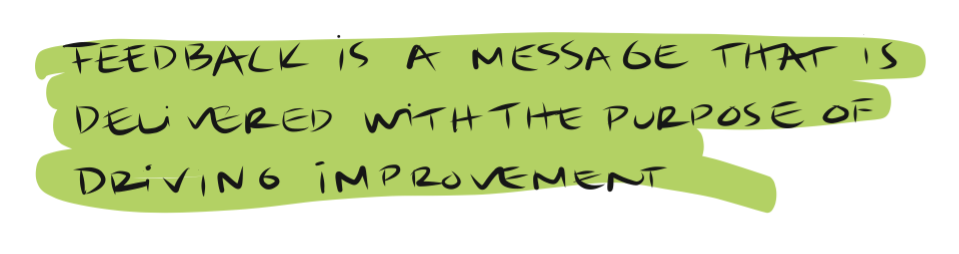
When I talk about feedback I mean observations and opinions we share with someone with the purpose of making them change a behavior or improve in another way. The change could be building on something positive, where you want to encourage them to continue doing something, or it could be that you want them to stop do something or to improve something.
When sharing your observations and opinions as feedback you need to be specific. You need to help the person understand what you mean and give concrete examples to clarify your statements. To support the change you are after your feedback has to be actionable so that the actions you want to encourage can be repeated and the actions you don’t want to see can be avoided in the future.
Saying I appreciate that you are helpful, without telling them what you consider as helpful, will not enable them to action on this feedback. If you instead say I appreciate that you helped me cleaning up the breakfast yesterday, since it goes so much faster when we do it together will tell the person what you considered helpful and why.
The key for success
There are lots of things to say about feedback and lots of ideas of how to give it in a good way but there are two high level things that I think are more important than all the others; practice makes perfect and it’s not about you, it is about the feedback receiver.
Practice makes perfect
It might be scary and difficult to give feedback to others but the only way to reduce the fear and make it easier is to practice. The more you do it the easier it gets and if you avoid it you will never learn (and you will miss the opportunity of helping others learn).
When I first became a manager I struggled a lot with giving negative feedback to people and I have developed some tactics that makes it easier for me.
- Give lots of positive feedback to get to practice. In my experience people do good things everyday and if you pay attention to this will find lots of things that you could give positive feedback about. Focusing on giving positive feedback is a way to do it more often. For me it is also easier to give negative feedback to someone when they are used to me giving feedback in general. When giving positive feedback, be mindful about that a phrase like “good job” might be encouraging but it is not feedback since it is too indirect. Also praising things that are not a big deal can take the value out of the feedback. So even if you go for quantity, you still need to make sure to always give qualitative feedback.
- Prepare your feedback statement before giving it. If you feel that it is challenging to give feedback to someone it is valuable to think through what you would like to say beforehand. It could even be valuable to write it down word for word, even if you are going to give it verbally. Practice giving the feedback message, in a role play together with a colleague that you trust, can also be super valuable.
- Give immediate feedback. The closer to the situation the better. When doing it close to the event both you and the person have the context fresh in memory which makes it’s easier to relate to the feedback. But if you missed the opportunity, giving feedback later is better than not giving it at all. In that case I often start with something like I have reflected a bit about the situation … and found that I actually was not appreciating … so even if it’s been a while I would like to bring this up since I think talking about this will help us …
It’s not about you, it is about the feedback receiver
When taking action it is easy to think about that action in your own perspective. And when we are doing something that is a bit uncomfortable we often have a strong internal drive to get it overwith.
When you are giving feedback the purpose is to create a change and the person that needs changing is (in your perspective) not you, but the other person. Success for your feedback moment will therefore be that you share your message and the other person receives, understands and accepts the message. This means that just saying your message will not be enough and you need to focus on sending a message that can get all the way to acceptance. The acceptance is about the person acknowledges that a change is needed which is the first step towards a solution.
To reach acceptance in your feedback moment you need to give your message in a way that will be as easy as possible for the other person to take in. This is not about sugar coating, or being nice, but instead about creating a setting where the person has a good possibility to safely take in the message. Some things that I think about when phrasing a feedback message is:
- Make my intent clear, why am I giving this feedback and why do I think it will help the other person changing their behavior in the way I want.
- Paint a picture of the consequenses of the current behavior that I think needs changing, to give a clear purpose for the change I am asking for. This could be about creating an understanding around how this behavior impacts other people, like me or the team.
- Phrase the message in a way that makes it easy for the person to understand what I am meaning. I think about their perspective, what they will be thinking of and what is important for them so that I can bring up things that will make my message as clear as possible.
- Phrase my message in a way that will not put the person in “defensive mode”. This might be unavoidable but I think carefully about this since acceptance of the problem will not come as long as the person is feeling defensive.
- Be super clear with what I would like that the person should change and if possible I will also offer to help the person on that journey to hold out a helping hand. I will be mindful of not making that helping hand take over the responsibility for the change, it is super important that the other person will own doing the change.
Several of the examples above are about giving negative feedback but the advise is applicable for positive impact as well. The acceptance will be easier to reach but it is as important that the individual truly understands what you are appreciating, and why, so that they can repeat that behavior appropriately in future situations.
Situational or generic feedback
In a good feedback culture you need a combination of situational and generic feedback.
You need people to actively give situational feedback when appropriate, both positive and negative. With situational feedback I mean feedback about a particular moment. Changing behaviors are difficult and actively getting situational feedback will support people in growing their behaviors.
Doing a feedback round, for instance twice a year, is something I have seen being really valuable for long term growth. Asking other people for generic feedback around how you are doing will help you identify your strengths and find new areas for improvement. Looking back at previous feedback rounds is a great way to track growth or lack of growth. Which feedback is coming back and which feedback is no longer appearing?
Asking for feedback
Asking for feedback is an excellent way to learn more about your strengths and weaknesses. And to practice your receiving feedback skill. When you are asking explicitly for feedback it can also be easier for people to be honest and say even the things that might be difficult to say.
Asking for immediate feedback. One way to ask for feedback is to ask questions in connection to a specific thing. It could be to end the meeting with a few questions around what was good and what could have been better or to ask for feedback around some work that you have produced. The questions you pose can be generic as “good vs bad” or more specific if there are certain things that you would like to get people’s opinions about. The way you phrase your questions will bias the answers you get so think carefully about what you want to learn from them.
Asking for generic feedback. Generic feedback is something that you can ask for to learn more about your strength and weaknesses and as stated above, the way you phrase the questions will impact the answers you get. One set of questions that could give you generic answers are:
- In our work together, what value have I provided to you? Delivering value is what work is about and this question will highlight the impact you are having seen from others perspective
- What are the things you think I do well/which behaviors of mine do you appreciate? This question will highlight the things that people appreciate working with you and that they would like you to continue with.
- What are the things you think I should improve/which behaviors of mine do you think I should work on improving? This question will highlight your improvement areas, the things that people would like you to change.
- Anything else you would like to mention? This questions will give space for people to mention other things that might not have been covered in the other questions.
Asking for specific feedback. When there is something specific you would like to learn more about, asking for feedback with more specific questions can be a good idea. If you are afraid that people will feel uncomfortable being honest, phrasing the questions in a way where it is as easy as possible for them to be honest is helpful.
If you, as an example, are wondering about if people find it easy to pair up with you or not, some example questions could be:
- How do you experience pairing up with me? An open question that does not steer the answer in any direction. If they are comfortable being open you can learn about both strengths and weaknesses from this question.
- Since I want to improve my collaboration and pairing up skills; what do you think I could focus on improving? When stating that the purpose of the question is that you really want to learn how to improve it will be easier for people to bring up your weaknesses.
Giving feedback to others
To be able to give feedback you need to have something to say. You need to have some observations and ideas of improvements to share.
You need to be good at observing. Observing is about having a meta-thread continuously running that picks up things that people are doing and in the way they are doing them. For instance if someone is showing behaviors that are either helping the team forward/slowing things down or behaviors that include/exclude others. You can choose to give feedback around your observations immediately or take a note to give it later.
Writing notes is very helpful. Your mind easily forget these things why it can be super valuable to take some notes on the things you have observed. These notes can be stored in your head or written down somewhere. Written notes will be helpful to be able to give good and concrete feedback since it is so easy to forget the details needed to paint a clear picture.
Give feedback immediately but keep the notes. Everyone praises the value of giving immediate feedback and I totally agree. Close to the event the context is fresh and the likelyhood of reaching the understanding phase in the feedback moment is much higher then. Combining the immediate feedbacks with more holistic feedback rounds is really good since you in the holistic round will be able to see patterns in behaviors that you are not seeing in the moment. Keeping the notes from the immediate feedback will make it easier for you to give good feedback in the holistic round.
Examples of ways to give feedback
Example 1 – The Hamburger
On my first manager training, many years ago, I learned an easy to follow technique to deliver negative feedback. Doing this was really challenging for me to begin with and the technique really helped me deliver this kind of feedback successfully. Let me introduce you to the hamburger:

- The top bread: Something nice as the opener.
- I think it is great that you are so engaged in our meetings…
- The hamburger: The negative message.
- …but when you constantly interrupt me I feel unimportant like my opinions are not worth anything……and I would be happy if you would not interrupt me when I am talking going forward…
- The bottom bread: Something good to leave.
- ...since I really appreciate the value you bring to our discussions it’s important for me that this is going to work.
Don’t forget that a key for success is to prepare your message before giving it.
I have also used the hamburger technique when communicating other kinds of messages as well, both to individuals, teams or organizations. It is really helping to end on a somewhat positive note even when the message is sad.
Example 2 – Getting your message through

Giving feedback based on your perception and your feelings is an approach that can work when you want to avoid an argument around the situation. Your feelings are your own and can not be right or wrong. When giving the feedback you want the person to understand that their behavior did made you feel in a certain way. You don’t want to end up in a discussion around if the other persons actions were done by the right reasons or not, since those facts will not change anything about how you felt in the particular moment.
In this example one person felt ignored when the other person constantly interrupted them in a meeting. Remember that there is not one right way to give feedback and no guarantees that this way is the right way for you or your situation.
Step 1: Prepare the feedback. Reflect on your observations and why you think it is important for the other person to change their behavior. And think about how you can phrase your message in a way to make it come through.
Step 2: Give the feedback.
- I think it is important for us to have a well functioning collaboration and that is why I would like to give you some feedback. This is about showing your intent with having the conversation.
- In the previous meeting I experienced that you interrupted me a lot, for instance when I was talking about the new project. This is about setting the stage and giving an example to make it easier for the person to understand.
- When you interrupt me, I feel ignored and questioned which is an unpleasant feeling and it is also reducing my ability to have influence on the rest of the team. This is about the consequences of the thing you are bringing up in your feedback.
- We are striving for an environment where everyone gets heard and what I would like to see is that you will stop interrupting me in the future. This is about showing how you would like things to be and why that is better.
- I am assuming you are not doing this intentially but since this is hurting our collaboration I want you to be aware of this. Getting our collaboration to work is important to us why I really hope that you work on improving this going forward. This is about making it easier for the other person to accept your feedback and not go into defensive mode and state that your intention with this feedback is to make things better.
Step 3: End the “giving feedback state”. Now it is time to end the feedback giving state and you could choose two different paths depending on the situation. The goal with the feedback is to make something change, in this case, make the person stop interrupting you in meetings. To reach that goal you want to end the conversation with the other person accepting that you would like this change, and hopefully also an with and agreement around that doing this change will be good for the both of you. The thing you would like to avoid is leaving the meeting with an undermined feedback statement. You felt interrupted in the meeting and there is nothing that can change that history why you want that feedback to be accepted. Two examples of ways to end the session are:
- Example 1: What do you think about this? What was your perception of the situation in the meeting? This will be opening up for more perspectives and potentially good next steps to improve your collaboration going forward.
- Example 2: I felt it was important for you to know about my experience from the last meeting why I wanted to give you this feedback, if you after reflecting on this a bit have questions or wants to discuss something, just let me know. The idea is to end the feedback session right here, with your message as it is. But since it is important that you open up for improving the collaboration it is good to invite further discussions later on. If this statement is creating a too big risk for your statement to be weakened I would recommend leaving the second part out.
Ending the feedback giving by opening up a conversation around the other persons perspective, as in example 1, will be good to state that you think that both persons perspectives are important and that you see that it takes two people to make a collaboration work. Opening up the conversation, as in example 1, might be a bad idea if you see a risk that your feedback message will become undermined in the following conversation. If you see that risk I would recommend ending the meeting directly after the statement has been given, like in example 2.
A small note on being emotional. Being a woman in tech makes me being aware of gender biases and mindful about my own actions. In this example I am using my feelings as a tactic to phrase a message that can not be argued about. Talking about feelings is something that can come out as “soft” or “weak”, and if you work in an environment where being “soft” is not appreciated you might want to add some more logical reasoning to your emotional message to not play too much into the gender biases and stereotype thinking.
What is the gift in this example? In this case I am focusing a lot on making the feedback sender successfully send the feedback message through to the receiver. This could be seen as focusing on the sender getting their things said. The way I think about it is that the purpose of the feedback is still not about getting the feedback sent, but to create a change in behavior at the receiver end. And this change will benefit both the sender and the receiver why I think that this feedback is a gift to the receiver even when it might not be perceived at that in the conversation. So, for me, it all comes down to purpose and intention.
Giving Feedback in a Leadership Role
As a leader in an organization you have an important role to play building a feedback culture. The way you are working with feedback will be influencing others why it is important to be a good feedback role model.
Another thing to remember when giving feedback is that your leadership role might give you formal powers that makes you “stronger” in the feedback moment. This makes it even more important for you to phrase your message in a way where it can be received well.
When I want my feedback to change an inappropriate behavior I am focusing a lot on making my message super clear, after the feedback has been given there can not be any room for interpretation, there must be one message and no fluffiness.
When my feedback is more targeted supporting growth of a team or an individual I make more room for discussion. My opinion is always subjective and when it comes to a person’s growth, that person is the one who has the most knowledge. My opinion will be influenced by what I have been observing without having the full context. I will not know what the person was thinking of, which decisions he/she were taking before taking the actions that I have been observing. I will state my observations in relation to my beliefs but think that combining those with a conversation with the person is super valuable to enrich and validate the feedback.
Non feedback can also be feedback
If you are in a leadership role your actions are always observered by people in the organization and if you are seeing a certain behavior that you are not appreciating and do not point them out, that is the same as a silent “OK”. This makes it even more important that all leaders step up to the feedback challenge, even when it is difficult. And in some situations having a feedback session behind closed doors might not be enough, it might need to be combined with a clear statement from leadership to the organization around which behaviors that are accepted and not.
I have experienced situations when people have gotten feedback about short comings or lost opportunities when it is time for compensation review. I belive that is too late and unfair. As leaders we have a responsibility to express our feedback in a timely manner so that people get a fair chance to adjust their behaviors and actions. If we stay silent and bring this up when it is time for evaluting the performance we have failed as leaders.
So as a leader, you have to act on the things that are not working as they should, not giving feedback is not ok.
Don’t forget to learn from the feedback experience
When ever possible I end a feedback session with asking about which value my feedback provided. What did the other person learn from my feedback and how did the feedback support those learnings and new insights. This is an awesome way to continuously learn the most from the feedback moments you have.
Don’t underestimate the power of positive feedback
Giving positive feedback can help people strengthen the things they do great which could be as powerful as correcting “bad” behavior. Praising good behavior builds a positive culture where people feel strong and appreciated which is a really good start for doing great things. Remember that all feedback needs to be specific and relevant to have an effect and that praising mediocre work can have the opposite effect on motivation.
Finally, for me it feels easier to give negative feedback when the person knows that I am also noticing and giving feedback on the positive things. So having a positive balance on the “feedback account” can make it easier to say the hard things.
 Engineering Leadership in Practice by Åsa Ranneby